
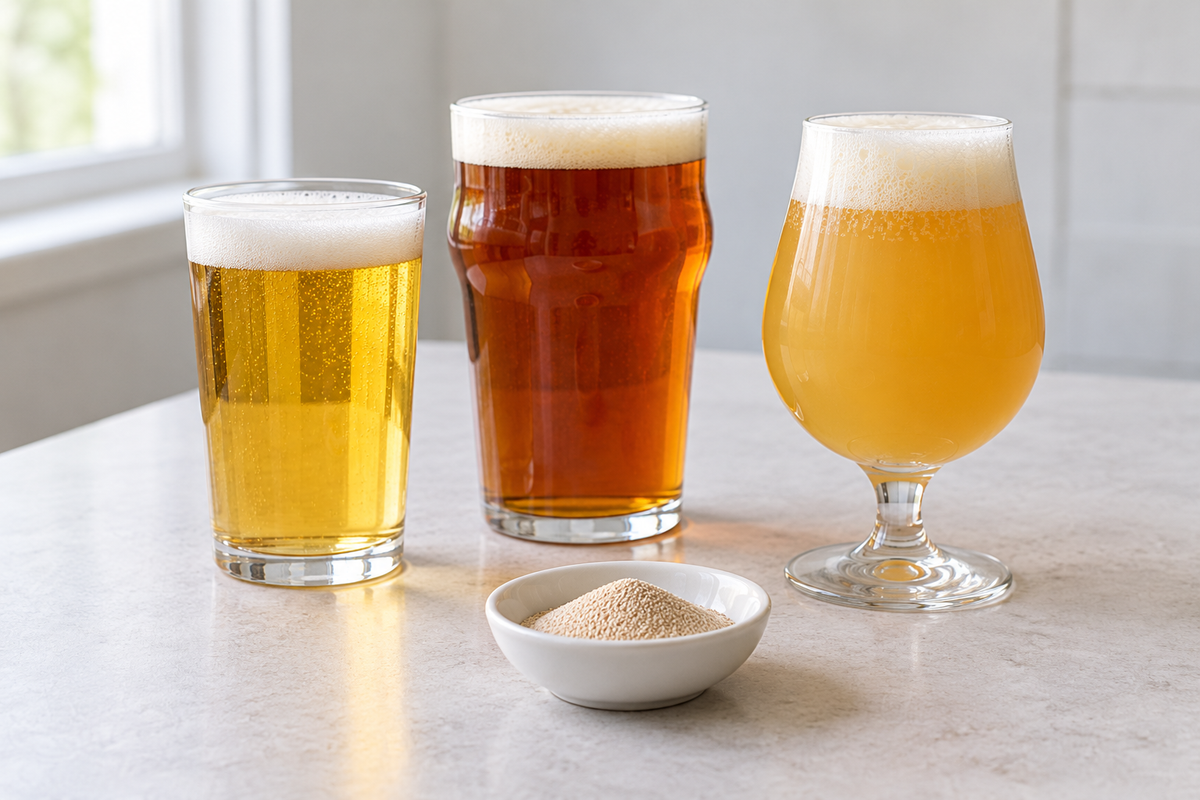
The right beer yeast depends on the beer you want to make and the conditions you can maintain. A strain chosen for a fruity bitter will give a different result from one selected for a clean lager, even before you consider the malt and hops.
This guide explains how to compare brewing yeast by flavour, temperature, attenuation and pitching rate. Use it alongside our beer yeast range, then follow the current instructions for your chosen strain and recipe.
Decide on the flavour you want, check the temperature you can hold, then calculate the amount of yeast for your batch. Those three checks are more useful than looking for one “best” yeast.
What Is Beer Yeast?
Beer yeast is a living microorganism that ferments sugars in wort, the sugary liquid prepared from brewing ingredients. It produces alcohol, carbon dioxide and compounds that contribute to the finished beer's aroma and flavour.
Some strains contribute relatively little flavour. Others produce fruity esters or the spicy notes associated with particular styles. The yeast also influences how far fermentation proceeds and how readily it settles afterwards. It works with your recipe: changing yeast alone will not turn any malt extract kit into any beer style.
Brewing yeast is different from inactive nutritional yeast sold as a food ingredient. If you are buying “brewer's yeast”, check that it is a live fermentation product intended for making beer.

Ale Yeast or Lager Yeast?
Ale yeast is used for bitters, pale ales, IPAs, stouts, porters and many Belgian, wheat and farmhouse beers. Some ale strains give a neutral profile; others make fermentation character a prominent part of the beer.
Lager yeast is used for styles such as pilsner, helles and Märzen. Many traditional lager fermentations run cooler than typical ale fermentations, so the temperature of your brewing space matters when choosing a strain.
There are exceptions within both groups. A kveik strain and a British ale strain can have very different requirements, while lager strains vary in the conditions they tolerate. Read the individual specification rather than using “ale” or “lager” as a complete temperature instruction. Our lager versus ale guide explains the wider style differences.
Choose Yeast for the Beer You Want
- Bitter, mild or a traditional British ale: look for an English-style strain with the fermentation character and finish your recipe calls for. Gentle fruitiness can be part of the intended flavour.
- American pale ale or a clear, hop-led IPA: a relatively neutral American ale strain is a useful starting point when you want the hops to remain prominent.
- Hazy or fruit-forward IPA: compare strains selected for an expressive fruit profile. LalBrew Verdant IPA, for example, is associated with apricot, tropical-fruit and citrus character. Haze and body also depend on the recipe and process.
- Lager or pilsner: choose a suitable lager strain and plan the fermentation and conditioning temperatures before brew day.
- Belgian, wheat or saison: use a strain selected for the style's characteristic fermentation flavours. A neutral ale yeast will produce a different result.
Browse ale yeast, lager yeast, IPA yeast and speciality beer yeast to narrow the choice.
Three Beer Yeasts to Compare
These examples show why it helps to choose by the intended result rather than sachet size alone. They are starting points for suitable recipes, rather than interchangeable replacements.

An English ale option with fruity and floral character and a strong tendency to settle.
View yeast and instructions
A neutral American ale option for recipes where you want malt and hops to lead.
View yeast and instructions
A lager option with a restrained fermentation profile. Check your temperature control and pitch rate.
View yeast and instructions| Yeast | Main character | Ideal range |
|---|---|---|
| SafAle S-04 | Fruity and floral ale | 18–26°C |
| SafAle US-05 | Neutral American ale | 18–26°C |
| SafLager W-34/70 | Restrained lager profile | 12–18°C |
These ranges are specific to the named strains. They do not mean every point within a range produces identical flavour, or that the same temperatures suit other products. Check the current manufacturer guidance and your recipe before choosing a target.
Temperature, Attenuation and Flocculation
Temperature: match the yeast to your setup
Check the liquid temperature, not only the room. An active fermentation can generate heat, and a cupboard that feels cool in the morning may warm up during the day. Aim for a steady fermentation within the strain's recommended conditions.
If you cannot hold the conditions a recipe needs, choose a better-suited recipe and yeast or arrange temperature control first. Do not assume a lager strain will give the intended result simply because the room feels colder than usual.
Attenuation: how far the wort ferments
Apparent attenuation describes the reduction in gravity during fermentation. For a comparable wort, a higher-attenuating strain generally reaches a lower final gravity. The fermentability of the wort also matters, so the published percentage is a guide rather than a guaranteed result.
Use this specification when comparing a drier finish with a recipe intended to retain more body. It does not tell you the final ABV on its own.
Flocculation: how yeast clumps and settles
Flocculation describes yeast cells clumping together and settling. A strongly flocculating strain may help with clarification and handling, but clear beer is not proof that fermentation has finished. Hops, proteins and the rest of your process also influence appearance.
Check alcohol tolerance for stronger recipes too. A stated tolerance is an operating guide, not a method of stopping fermentation at a chosen sweetness.
How Much Beer Yeast Do I Need?
Use the manufacturer's pitching rate for the specific yeast, batch volume, original gravity and fermentation conditions. A 10g, 11g or 11.5g sachet is a pack size; it is not a universal dose for every homebrew.
Where the instruction is given in grams per hectolitre, one hectolitre is 100 litres. The calculation is:
Yeast in grams = batch volume in litres × pitching rate in g/hL ÷ 100.
For example, Fermentis publishes 80–120g/hL for W-34/70 at its stated ideal temperatures. For a 23 litre batch, that converts to 18.4–27.6g. Two 11.5g sachets supply 23g, which falls within that range. This is a worked example for that yeast and those conditions, rather than a rule for every lager.
Stronger wort or different fermentation temperatures may require a different pitch. Use an appropriate manufacturer calculator where available, such as the Lallemand dry yeast pitching calculator. Adding more yeast does not create more fermentable sugar or automatically increase the beer's strength.
How to Add Dry Beer Yeast
- Check the sachet. Confirm the strain, date, pack condition and storage instructions before brew day.
- Prepare the wort. Clean and sanitise the fermenter and anything that will touch the cooled wort. Measure the starting gravity and check the liquid temperature.
- Measure the required yeast. Use the quantity specified for your recipe and fermentation conditions.
- Follow the preparation method. Direct pitching and rehydration are different approaches. Use the current instructions for that product; rehydration water temperature may differ from the fermentation temperature.
- Maintain suitable conditions. Fit the fermenter lid and airlock as intended, then monitor fermentation without repeatedly opening the vessel.
Fermentis permits direct pitching for the three strains compared above. That does not make one preparation method universal across all brewing yeasts. Keep any opened yeast according to its manufacturer's instructions and do not assume it retains the unopened pack's shelf life.
Changing the Yeast in a Beer Kit
The yeast supplied with a beer kit is the straightforward starting point for making the recipe as intended. A change can be useful if you deliberately want a different fermentation profile, but a separate sachet is not automatically an improvement.
Compare the replacement's flavour, attenuation, temperature needs, alcohol tolerance and pitch rate. A more attenuative yeast can change the finish; a more expressive strain can add fruit or spice that was not part of the original recipe.
If you are still learning a kit, brew it as supplied first. That gives you a useful comparison before changing one ingredient at a time. Our ale kit buying guide covers the other contents and additions to check.

Check Fermentation Before Bottling
Airlock bubbles show gas passing through the airlock. They do not tell the whole story: a lid leak can reduce visible activity, while beer can release dissolved gas after the main fermentation slows.
Use suitable stable hydrometer readings, consistent with the recipe and the yeast's expected performance, to confirm fermentation has finished before packaging. Stable but unexpectedly high gravity needs investigation; cold or stalled yeast can begin working again later.
Our hydrometer guide explains how to take a reading. Follow the recipe for priming and conditioning, using packaging designed for the intended pressure.
Beer Yeast FAQs
What is the best beer yeast for beginners?
Start with the yeast supplied with your kit or the strain specified in a straightforward recipe. A yeast you can ferment at the correct temperature is more useful than a popular strain that does not suit your setup.
Can I use bread yeast to brew beer?
Bread yeast can ferment sugar, but it is selected for baking. For a beer with published flavour, temperature and pitching guidance, choose a brewing strain intended for the style.
Is nutritional yeast the same as beer brewing yeast?
No. Nutritional yeast is an inactive food ingredient and cannot replace live fermentation yeast. Check the product's intended use rather than relying on the words “brewer's yeast”.
Do I need yeast nutrient for beer?
Not for every recipe. The need depends on the wort, yeast, strength and brewing process. Use a suitable beer nutrient where the recipe or manufacturer recommends it, rather than applying a wine nutrient dose to beer. Read our yeast nutrient guide for more detail.
How long does beer yeast take to ferment?
There is no fixed time for every strain or batch. Temperature, gravity, pitching rate and wort composition all matter. Use gravity readings and the recipe's guidance rather than bottling after a set number of days.
Should I add more yeast if there are no bubbles?
Take gravity readings and check the liquid temperature first. Lack of airlock activity alone does not establish that yeast has failed. Work out whether fermentation has started, finished or stalled before deciding what to add.
Ready to choose? Browse our beer yeast collection. If you need a hand, tell us the beer style, batch volume, original gravity and fermentation temperature you can maintain.
Manufacturer and technical references: SafAle S-04, SafAle US-05, SafLager W-34/70, LalBrew Verdant IPA and the BJCP guide to yeast and fermentation. Guidance checked 24 October 2026; always check current packaging and instructions.


