
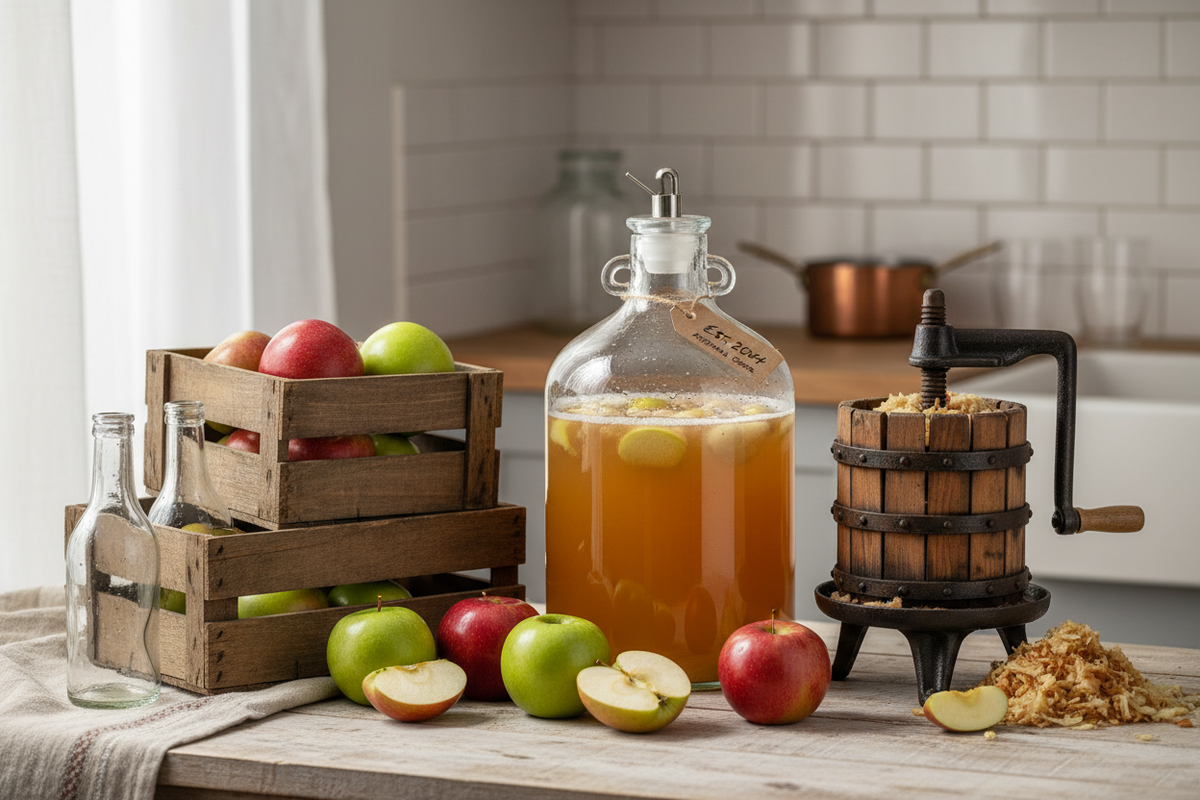
Making cider at home can be as straightforward as fermenting a purpose-made cider kit, or as hands-on as crushing and pressing your own apples. This guide explains both routes, the equipment you genuinely need, how to confirm fermentation has finished, and how to bottle still or sparkling cider safely.
Choose Your Cider-Making Method
Cider kit
Best for a first batch or consistent results. The concentrated juice and flavour components are prepared for you, and the kit instructions set the batch size and additions.
Fresh apples or apple juice
Best when you have usable fruit or want to build your own apple blend. Fresh apples must be washed, sorted, crushed and pressed before the juice is fermented.
Cider Kits and Useful Ingredients
These live products cover traditional apple cider, richer real-fruit styles, flavoured cider, yeast and clearing. Always follow the instructions supplied with the individual kit or ingredient rather than copying the dosage from another product.
 John Bull Country Cider KitA straightforward traditional-style cider kit.
 On The Rocks AppleA familiar apple cider with simple kit preparation.
 Festival Oaked AppleA fuller real-fruit kit with an oaked character.
 Mangrove Jack's Mixed BerryFor a fruit-led cider rather than a traditional apple profile.
 Gervin GV13 Cider YeastA dedicated yeast for fermenting apple juice.
 Harris Cider BriteA single-dose fining treatment when clearer cider is wanted.
Equipment You Need
- Fermenter: large enough for the intended batch with safe headspace.
- Airlock and suitable bung or lid: allows gas to escape while limiting exposure.
- Hydrometer and trial jar: confirms fermentation progress and helps calculate alcohol.
- Thermometer: helps keep fermentation within the yeast maker's stated range.
- Food-safe sanitiser: for every item that touches the juice or cider after cleaning.
- Syphon and tubing: for transferring without disturbing sediment. Never start a syphon by mouth.
- Pressure-rated bottles and closures: essential if the cider will be carbonated in the bottle.
Fresh apples also require a safe way to crush the fruit and a suitable press. A juicer can work for small quantities, although it often produces more fine pulp.

How to Make Cider from a Kit
- Clean and sanitise. Clean visible dirt first, then sanitise the fermenter, spoon, hydrometer equipment, lid and airlock.
- Prepare the concentrate. Add the kit contents and water exactly as directed. Different kits use different final volumes and additions.
- Check the temperature and gravity. Make sure the liquid is within the yeast's pitching range, then record the original gravity before adding yeast.
- Add the supplied yeast. Follow the kit directions for sprinkling or rehydrating it. Close the fermenter and fit the airlock.
- Ferment steadily. Keep the cider within the stated temperature range. Airlock activity can vary, so do not use bubbling alone as proof that fermentation has started or finished.
- Confirm completion. Take a hydrometer reading, then repeat it after the interval given in the kit instructions. Bottle only when the readings are stable and the expected final gravity has been reached.
How to Make Cider from Fresh Apples
- Sort the fruit. Use ripe, sound apples. Bruised fruit can be trimmed and used, but discard rotten or mouldy fruit.
- Wash, crush and press. Crushing creates a pulp that releases juice under pressure. Keep all food-contact surfaces clean.
- Measure the juice. Record the original gravity and assess the acidity and flavour. A blend of sweet, sharp and tannic apples often gives better balance than one dessert variety alone.
- Choose the fermentation approach. A cultured cider yeast gives more predictable results than relying on wild fermentation. Add sulphite, pectic enzyme, nutrient or other additions only according to a tested recipe or the product instructions.
- Pitch the yeast and ferment. Use a sanitised fermenter with adequate headspace and keep it within the yeast maker's recommended temperature range.
- Check with a hydrometer. When readings remain unchanged over the recommended interval, fermentation is complete. A quiet airlock is not enough evidence by itself.
Shop-bought 100% apple juice can also be fermented. Check the ingredients: ordinary ascorbic acid (vitamin C) is generally not a problem, but preservatives such as potassium sorbate or sodium benzoate can prevent or inhibit fermentation.
Racking and Clearing
Racking means transferring cider away from the sediment. It is optional for many kit batches and should not be repeated without a reason, because every transfer introduces some oxygen and contamination risk. If you rack, sanitise the receiving vessel and syphon, keep splashing to a minimum, leave the sediment behind, and minimise headspace during longer storage.
Some cider clears naturally with time. A slight haze is not automatically a fault. If you want to use finings or pectic enzyme, follow that product's directions and make sure it suits the cause of the haze.
Bottling Still or Sparkling Cider
Still cider
Once fermentation is confirmed complete, transfer gently into sanitised bottles and close them. Still cider does not need priming sugar. If you plan to sweeten it, use a properly controlled method; simply adding fermentable sugar before bottling can restart fermentation.
Sparkling cider
Use pressure-rated beer, Champagne-style or suitable swing-top bottles. Add the precise priming amount specified by your kit or a reliable carbonation calculator, distribute it evenly, and cap immediately. Condition at the recommended temperature, then store cool.
Common Cider-Making Problems
The airlock is not bubbling
Check the temperature and hydrometer reading. Gas may escape around a lid seal, so a still airlock does not necessarily mean the yeast is inactive.
The cider tastes very dry
Most yeast ferments the available apple sugar, so dry cider is normal. Sweetness can be adjusted safely at serving, with a suitable non-fermentable sweetener, or through a controlled stabilising and packaging method.
The cider smells sulphurous
Some sulphur aroma can occur during fermentation and may dissipate with time. Persistent or severe aromas can indicate yeast stress, unsuitable temperature or poor nutrition. Do not keep adding nutrient blindly—check the process and the ingredient instructions.
The cider is cloudy
Give it time and keep it cool after fermentation. Apple pectin can create a stable haze, particularly if the juice was heated. Pectic enzyme works best when used according to its directions; finings solve some clarity problems but not all of them.
Cider-Making FAQs
How long does homemade cider take?
Many kits ferment in roughly one to two weeks, but temperature, yeast and recipe all matter. Bottled sparkling cider then needs time to carbonate and condition. Follow the kit instructions and hydrometer readings rather than a calendar alone.
Can I use bread yeast?
It may ferment, but a cider or suitable wine/beer yeast offers more predictable attenuation, flavour and settling behaviour.
Can I use screw-top wine bottles?
Only for still cider, and only with closures designed to seal them. Standard wine bottles are not intended for bottle carbonation. Use pressure-rated bottles for sparkling cider.
Do I need to pasteurise cider?
Not for a straightforward dry or kit cider made with sound sanitation and packaged correctly. Pasteurisation is a specialist option for some sweet packaged ciders and requires precise temperature control; it should not be improvised in carbonated glass bottles.
Start Your First Batch
Choose a complete kit for the simplest route, or use fresh apples when you have the fruit and pressing equipment available. The Hop Shop stocks cider kits, yeasts, fermenters, bottling equipment and fresh-fruit processing equipment, with free UK delivery on qualifying orders over £70.
Shop cider-making supplies · Browse cider kits · Read the syphoning guide · Read the yeast nutrient guide · Ask The Hop Shop