
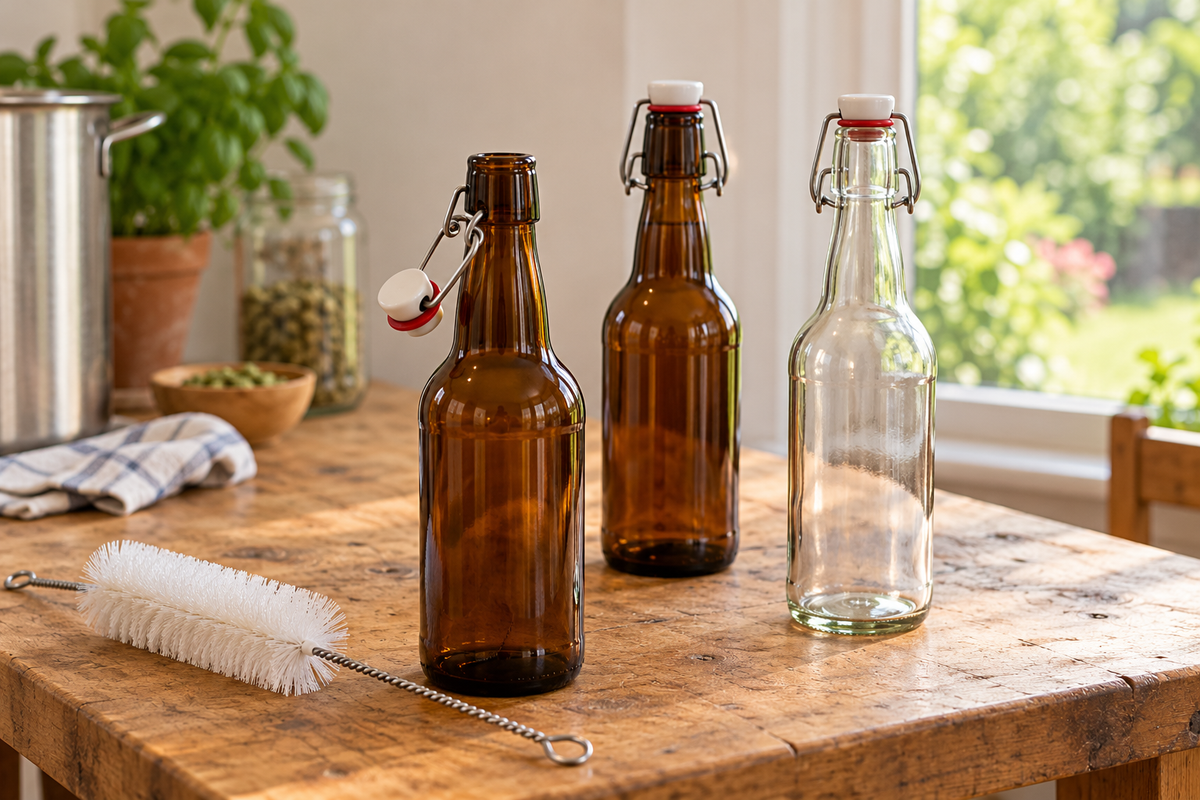
Flip top bottles are a convenient way to package homemade drinks without a separate capper. The attached stopper is easy to reuse, but choosing the right bottle still means checking the size, glass colour, closure and suitability for the drink you are making.
For carbonated beer or cider, use a bottle confirmed as suitable for the intended pressure. A swing top closure alone does not tell you what the glass can withstand.
Are flip top and swing top bottles the same?
In home brewing, the names usually describe the same style: a bottle with an attached stopper held down by a wire bail. Closing the lever presses a sealing washer against the mouth of the bottle. You may also see them called Grolsch-style bottles.
The stopper stays attached between uses, and you do not need crown caps or a crown capper. The bottle, stopper and washer still need cleaning, sanitising and inspection before every refill.
500 ml or 750 ml: which size should you choose?
Think about how much you normally pour at once, your available storage and the number of bottles you want to wash. A 500 ml bottle is a smaller serving; a 750 ml bottle reduces the number of closures to handle for the same batch.
| Bottle size | 12 bottles hold | For 20 litres | For 23 litres |
|---|---|---|---|
| 500 ml | 6 litres | 40 bottles | 46 bottles |
| 750 ml | 9 litres | 27 bottles | 31 bottles |
These are capacity calculations, rounded up where necessary. The last bottle may only be partly filled, and the actual packaged volume is usually lower after sediment and transfer losses. Keep spare bottles ready. A 500 ml bottle is about 0.88 UK pint, rather than a full pint.


Amber or clear glass?
Amber glass is a useful choice for beer because it reduces the light reaching the drink. Light exposure can cause unwanted changes to hop flavour. It still makes sense to keep amber bottles in a cool, dark place.
Clear glass shows the colour and clarity of the contents, which can be appealing for presentation. For beer, give clear bottles extra protection from light with a cupboard, carton or covered storage area.
Glass colour is separate from pressure suitability. An amber bottle is not automatically stronger, and a clear bottle is not automatically unsuitable: check the particular bottle specification.

Are all flip top bottles suitable for beer?
No. Some clip top bottles are intended for still drinks, sauces or oils. For example, Kilner explicitly excludes carbonated liquids from several of its clip top bottle listings. The closure style is therefore not enough to establish suitability.
For bottle-conditioned beer or cider, check that the complete bottle and closure are suitable for the carbonation you intend to produce. Do not guess a pressure limit from the bottle's appearance, weight or the fact that the stopper closes firmly.
Confirm fermentation has finished before packaging. For beer, take stable hydrometer readings over at least 48 hours and check that the final gravity is plausible for the recipe; unexpectedly high readings need investigation. Our hydrometer guide explains the measurement.
Measure priming sugar using your recipe or kit instructions and the actual packaged volume. A 750 ml bottle holds 50% more than a 500 ml bottle, so the same per-bottle sugar dose is not interchangeable. Follow the specific carbonation-drop instructions if using drops.
How to clean and sanitise flip top bottles
- Rinse promptly after pouring. Removing residue before it dries makes the next clean easier.
- Inspect the glass and closure. Set aside bottles with chips, cracks or a damaged neck, and replace deteriorated seals.
- Clean before sanitising. Use a suitable brewing cleaner and a bottle brush where needed. Pay attention to the stopper and the underside of the washer; remove a removable seal for cleaning.
- Rinse as directed by the cleaner. Then sanitise the bottle interior and all drink-contact parts of the closure using the sanitiser's stated dilution and contact time.
- Drain and protect until filling. Follow the sanitiser's rinsing instructions; only products labelled no-rinse should be treated that way. Avoid touching the inside of the bottle, stopper or seal.
You will find appropriate products in our cleaning and sanitising collection. Do not assume dishwasher cleaning reaches every surface or that every rubber or plastic part tolerates heat. Avoid pouring boiling water into cold glass; follow the bottle supplier's care instructions.
When should you replace the seal?
Inspect washers before each bottling session. Replace one that is split, brittle, perished, misshapen or no longer sitting evenly. Clean the contact surfaces before fitting the replacement.
Match the seal to the stopper, including its dimensions and shape. Our single flat rubber washer is listed for compatible ceramic swing top stoppers; that does not make it a universal fit for every flip top bottle.
A replacement washer restores a compatible closure's sealing surface. It does not give an unsuitable or damaged bottle a pressure rating.

What if the stopper or wire fitting is damaged?
Check the stopper as well as the washer. If it is cracked or the wire fitting is distorted, stop using that closure and replace it with a compatible part. Do not force a bent mechanism shut.
Our replacement swing top stopper with washer is sold individually. Compare it with your existing fitting before ordering; if you are unsure, send us a photograph and the bottle details.

Filling, storing and serving
Transfer the finished drink gently with clean, sanitised equipment and leave the headspace specified by your recipe or filling method. Keep the washer seated evenly before closing the stopper.
Condition beer as the recipe directs, then store it cool and away from light. Keep bottle-conditioned beer upright so sediment collects at the base. Chill before serving and pour steadily, leaving the sediment behind if you prefer a clearer glass.
For the transfer itself, see our guide to syphoning beer, wine and cider.
Frequently asked questions
Do flip top bottles need a capper?
No. A complete swing top closure seals using its attached stopper and wire lever. You still need a sound bottle, compatible washer and suitable cleaning and sanitising equipment.
How many 12-packs do I need for 23 litres?
Four 12-packs of 500 ml bottles provide 48 bottles and 24 litres of nominal capacity. Three 12-packs of 750 ml bottles provide 36 bottles and 27 litres. Actual fill volume varies with headspace and transfer losses.
Can I use decorative flip top bottles for beer?
Only if the manufacturer confirms they are suitable for the intended carbonation pressure. A decorative bottle or a clip closure is not enough evidence on its own.
Can swing top bottles be reused?
Yes, while the bottle and closure remain sound. Clean, inspect and sanitise them before each use, and replace damaged glass or worn parts rather than assuming they last indefinitely.
Are they suitable for kombucha or water kefir?
Check the bottle and closure specifications and follow a reliable drink-specific bottling method. These drinks can continue producing gas after bottling, so a general description such as “flip top” does not establish suitability.
Choose your bottles and spare closures
Browse our home brew bottles for 500 ml and 750 ml swing top bottles in amber or clear glass, with singles and 12-packs available. Compare the product details with your recipe before choosing, and check the fit of any replacement seals or stoppers.
Further reading: Kilner clip top bottle care and exclusions, Grainfather bottling guidance, Northern Brewer bottling guidance and cleaning and sanitising guidance from Arcane Alchemist.


